Five Minutes.
One Word.
Clear the Noise.
If you've been feeling mentally cluttered, emotionally stuck, or just a little disconnected — from yourself or the people around you — this is for you. You don't have to be a writer. You just have to show up.

Your information will never be sold or shared with third parties. By submitting this form, you consent to receive occasional emails about FreeWriters, the Mindful Midlife Community,
and offers related to personal growth and community events. All emails include an unsubscribe link.
A creative mental reset.
FreeWriters exists to give people a simple, accessible way to move their thoughts out of their heads and onto the page. It addresses a challenge most of us know well: feeling mentally overwhelmed, emotionally stuck, or disconnected — without a clear way to process what's actually going on.
Here's how it works. A lucky someone picks a random word, and everyone writes continuously for five minutes — no stopping, no editing, no waiting for the right thought to arrive. If you get stuck, you write I don't know what to write until something shows up. And something always does.
Afterward, you share if you want to. No feedback. No commentary. We write, we share, and we listen. That's it.
Bring a notebook. Bring a pen. Bring whatever's been on your mind lately. We'll take care of the rest.
Real session prompts — any one of these can take you somewhere real:
- banana
- sidewalk
- window
- purple
- door
Somewhere between the second and third minute,
something usually gets honest.
Help people connect
by clearing out the noise.
Our mission is to help individuals, families, and communities express themselves honestly and create real connection — without pressure to perform, explain, or get it right. Everything we do comes back to three things.
Simplicity creates freedom.
One word. Five minutes. That's the entire format. The less the structure asks of you, the more room there is to write something real — without overthinking what you're supposed to be doing.
Creativity quiets noise and nerves.
Something shifts when you follow a random word across the page without stopping. The mental chatter settles. What you've been carrying starts to find its way out.
Expression beats perfection.
There's no good or bad here, no right or wrong place to land. The goal is movement, not meaning. When you stop performing for yourself, the page usually gives you something worth keeping.
FreeWriters works wherever people gather.
The format adapts across age groups, environments, and organizational contexts. The structure stays the same regardless of who's in the room.
Individuals
If your thoughts feel like they're running in circles, this gives them somewhere to go. You don't need to solve anything in five minutes. You just need to move it from inside to outside. That shift tends to be quieter than you'd expect — and bigger than it sounds.
Parents & Families
A lot of families don't need more conversation — they need a different entry point. Writing side by side, without any pressure to explain what you meant, tends to open things that a direct question never could. If you've been trying to reach someone and keep running into a door that won't quite open, this is worth trying.
Students & Teens
Not everyone can answer "how are you doing?" with any accuracy. Give someone a random word and five minutes, and something usually finds its way out. This is especially useful for students and teens who have a lot going on inside and just need a lower-pressure way to get it on the page.
Educators & Facilitators
Simple to run, easy to adapt, and no prep required. You get a word, you set a timer, and you write. It works in classrooms, advisory periods, staff meetings, and group settings — and it does what most writing activities don't: it invites participation without making anyone feel like they're being evaluated.
Corporate Teams
FreeWriters works in corporate settings because it requires nothing of people except showing up and writing. No icebreakers. No forced sharing. No "turn to your neighbor." Just five minutes and one word — which is often enough to shift the energy in a room. Teams experiencing communication breakdowns, low engagement, or the disconnection that comes with hybrid and remote work have used this as a kickoff, a wellness initiative, an onboarding ritual, and a recurring practice that builds something harder to manufacture: trust. The outcomes tend to show up in the places organizations care about — communication, cohesion, and employees who feel more present and less guarded.
The data we care about most.
Week after week, people walk out with something they didn't have when they arrived. Here's some of what they've said.
"Much less scary than I thought. I was worried I couldn't get out of my head, but the feelings and words flowed freely."— Dusty
"This is where I'm meant to be. I feel wholly connected in these spaces, allowing my creativity to flow."— Jill
"It was nice to put the phone down, step away from social media, and just be fully creative."— Robyn
"I was struck by how a single word can start you down one path, but quickly an overriding emotion or issue can then surface."— Randall
"The answer came easily. Connection. Connection with myself, with others, and with simply being present."— Hannah
"Working from home can feel isolating sometimes, so moments like this really remind me of how much I enjoy feeling connected to other human beings."— Rebecca
The people who hold the space.

Nate Johnson
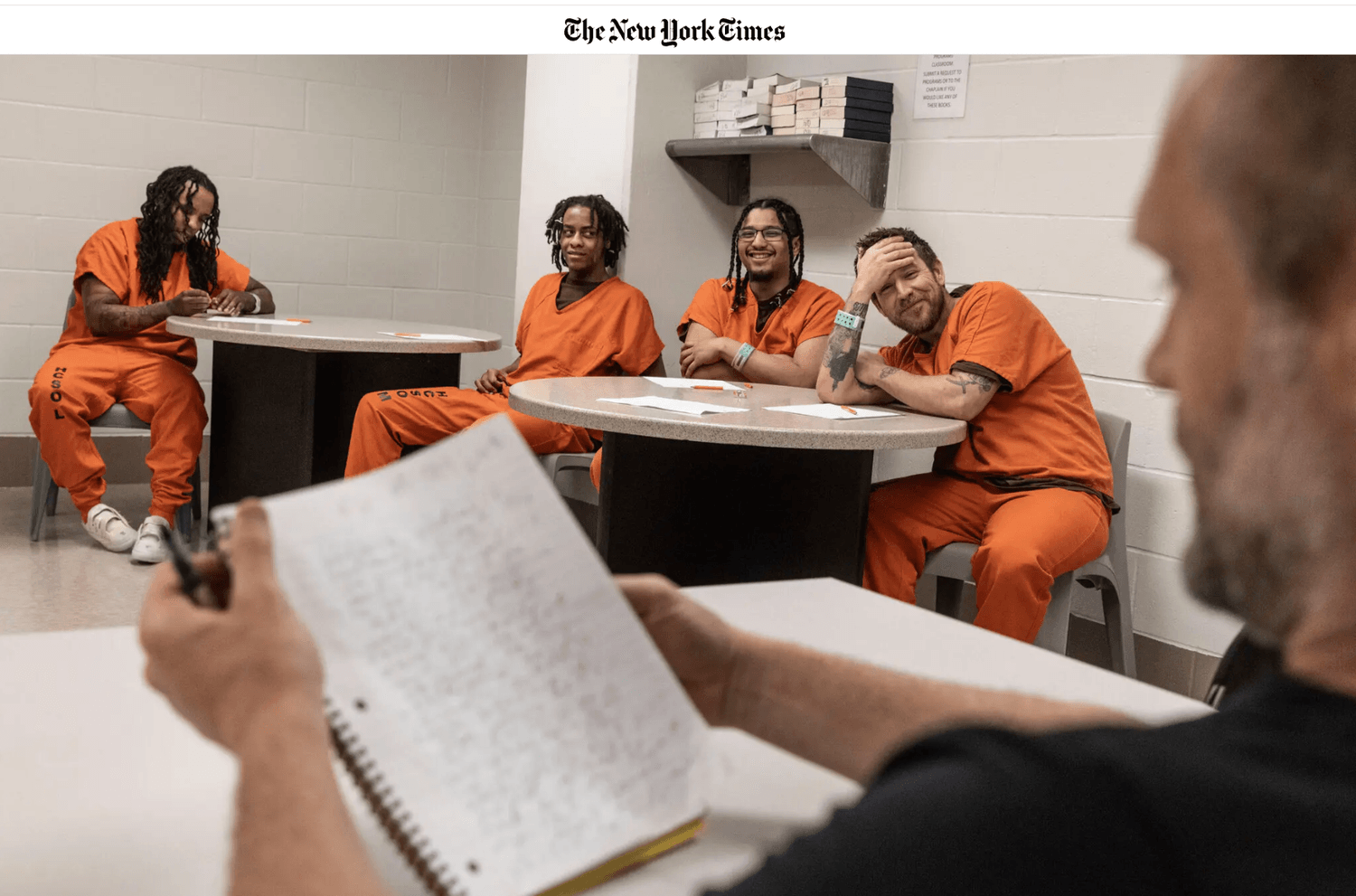
Founder · Navy Veteran · Former Prosecuting AttorneyNate developed FreeWriters while working directly with incarcerated individuals in Minneapolis-area jails — bringing a simple but demanding structure to people who needed a way to put their experience into words without having to justify or explain it first.
What started as a writing exercise became something more: a practice that gave participants access to thoughts they hadn't yet found language for. Nate took that same structure out of the jails and into communities, schools, and living rooms — and it worked exactly the same way everywhere.
As featured in The New York Times →
Billy Lahr
Creative Director · Educator · Certified Mindfulness Meditation TeacherBilly spent two decades in classrooms and advisory spaces, working with students who were willing to express themselves — they just needed a different way in. As an English teacher and dean of students, he learned that the students labeled "difficult" were often just waiting for the right structure.
He brings FreeWriters into homes, schools, and community spaces — and into the global Zoom sessions where people from across the world show up week after week to write, share, and listen. His job isn't to interpret what you write. It's to hold the structure so you can.
Show up.
Write.
Leave lighter.
Every session follows the same structure — which means nothing to prepare, nothing to bring, and no experience required. You show up, you get a word, you write for five minutes, and you share if you want to.
Session One
Session Two
Join any session, any week.
No commitment required.
No cost, no catch.

Join us this week.
No prep needed. No writing experience required. Just a notebook, a pen, and five minutes of willingness to follow wherever the words take you.
Bring FreeWriters
to your community.
The same practice that works in a weekly Zoom session works in a classroom, a conference room, or a community hall — with no materials, no setup, and no prior experience from participants.
Reach out if you're interested in exploring what that could look like for your group.
- Parent–child workshops
- Classrooms and advisory periods
- Educator professional development
- Teen and youth groups
- Community reflection circles
- Corporate team-building and offsites
- Employee wellness initiatives
Interested in bringing FreeWriters to your school, organization, or event? Reach out directly.
Get in TouchThe only rule is to keep writing.
No performance. No pressure. No waiting until you have something worth saying. You'll figure out what you have to say by writing it.